

We take "light propagation path" as the core logic, starting from backlight emission, gradually dismantling the role of each module, and clearly explaining how TFT LCD displays achieve precise pixel control. The whole process is accompanied by popular interpretation, avoiding complex professional terms, so that readers with different knowledge backgrounds can understand.
(1) Step 1: Backlight module - the "light source heart" of TFT LCD display screen
As mentioned earlier, TFT LCD displays do not emit light themselves, and all light comes from the backlight module. This is the "first step" and the most fundamental step in the entire display process. The core function of the backlight module is to provide a uniform and stable white light source, laying the foundation for subsequent pixel color development. Its performance directly determines the brightness, uniformity, and power consumption of TFT LCD displays.
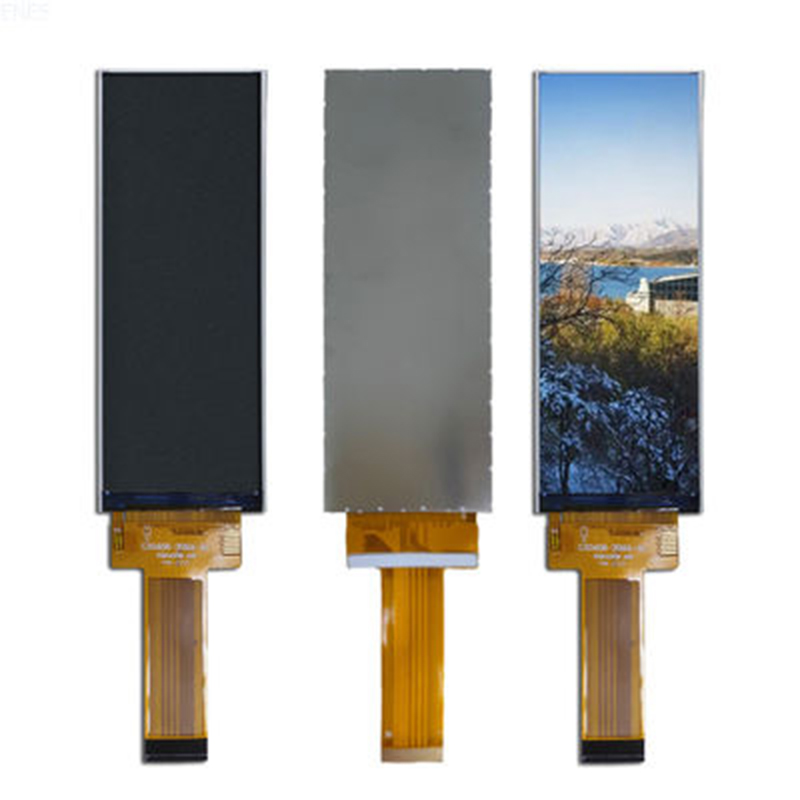
Core Detail Interpretation:
1. Backlight module composition: mainly includes LED beads (light source), light guide plate, diffusion film, and brightness enhancement film, among which LED beads are divided into direct type and side in type (currently the mainstream is side in type, thinner and lighter, with lower power consumption); The function of a light guide plate is to convert the point light source of LED beads into a surface light source, ensuring uniform distribution of light; Diffusion film and brightening film are used to improve the uniformity and brightness of light, reducing light loss.
2. Working logic: After the LED beads are powered on, they emit white light. The light enters the light guide plate and refracts through the microstructure of the light guide plate, diffusing the point light source into a uniform surface light source. After optimization through diffusion film and brightness enhancement film, the final output is a uniform and bright white backlight that illuminates the polarizer on the next layer.
Advantages of ESEN HK LIMITED: The TFT LCD display screen under ESEN HK LIMITED adopts high-quality LED beads and imported light guide plates, with backlight uniformity of over 95%. The brightness can be customized according to the scene (200-1500nit), and the backlight driving scheme is optimized. The power consumption is reduced by 15% -20% compared to ordinary TFT LCD display screens, which is suitable for outdoor, industrial and other multi scene needs.
(2) Step 2: Polarizer - the "directional filter" for light
The light emitted by the backlight module is "irregular polarized light" (which can be understood as "chaotic" light), which cannot be directly controlled by liquid crystal molecules. At this time, polarizing films (divided into lower polarizing film and upper polarizing film) are needed to play a "filtering" role, making the light become "unidirectional" polarized light, laying the foundation for the subsequent deflection control of liquid crystal molecules.
Core Detail Interpretation:
1. Polarizer (near the backlight module): Its function is to filter the irregular light emitted by the backlight module into linearly polarized light in a "single direction" (such as the horizontal direction). Only light that conforms to this direction can pass through, while light from other directions will be filtered out.
2. Upper polarizer (close to the observer): Its polarization direction is 90 ° perpendicular to the lower polarizer (compared to the horizontal direction of the lower polarizer and the vertical direction of the upper polarizer). Without the intervention of liquid crystal molecules, the filtered light from the lower polarizer will be completely blocked by the upper polarizer, and the TFT LCD display will appear "black" (no light passing through).
Key reminder: The polarization direction of the polarizer must be accurately aligned, otherwise it may cause excessive light loss, dark display, light leakage and other problems. ESEN HK LIMITED uses high-precision polarizer bonding technology in the production of TFT LCD displays, with an alignment accuracy of ± 0.01mm, effectively avoiding the above problems and ensuring stable display effects.
(3) Step 3: Liquid Crystal Molecular Layer - Precise Light Regulator
The liquid crystal molecular layer is the "core adjustment component" of TFT liquid crystal display screens, located between the upper and lower polarizing films. Its core function is to "control the amount of light transmitted" - by changing the deflection angle of the liquid crystal molecules, the amount of light transmitted can be adjusted to achieve different brightness displays, providing a basis for pixel color development.
Interpretation of Core Details (Popular Illustrations):
1. Characteristics of liquid crystal molecules: Liquid crystal molecules themselves have "anisotropy", which can be understood as "like small wooden sticks, they can freely deflect direction", and their deflection angle is controlled by external voltage - the higher the voltage, the greater the deflection angle; The smaller the voltage, the smaller the deflection angle; When there is no voltage, the liquid crystal molecules are in a natural alignment state.
2. Working logic: When the single directional polarized light filtered by the polarizer is irradiated onto the liquid crystal molecular layer, the liquid crystal molecules will "rotate" the polarization direction of the light (the rotation angle is consistent with their own deflection angle), and then the light will continue to propagate to the upper polarizer. Since the polarization direction of the upper polarizer is perpendicular to that of the lower polarizer, whether light can pass through the upper polarizer is entirely determined by the deflection angle of the liquid crystal molecules
① When there is no voltage: the liquid crystal molecules naturally align and rotate the polarization direction of the light by 90 °, which is exactly the same as the polarization direction of the upper polarizer. The light can completely pass through, and at this time, the area appears in the "brightest" state;
② When the maximum voltage is applied: the liquid crystal molecules deflect 90 ° and no longer rotate the polarization direction of the light. The light is perpendicular to the polarization direction of the upper polarizer, and the light cannot pass through at all. At this time, the area appears in the "darkest" (black) state;
③ When an intermediate voltage is applied, the liquid crystal molecules deflect by a certain angle, and the angle of the polarization direction of the rotating light also changes accordingly. Part of the light can pass through the upper polarizer, and at this time, the area appears as "intermediate brightness" (gray).
ESEN HK LIMITED Optimization: ESEN HK LIMITED focuses on the liquid crystal molecular layer of TFT liquid crystal displays, using high-quality liquid crystal materials and optimizing the molecular arrangement process to increase the deflection response speed of liquid crystal molecules to within 5ms, effectively avoiding problems such as image ghosting and blurring, and adapting to dynamic display scenarios such as industrial monitoring and automotive control.
(4) Step 4: TFT Array Substrate - Precise Controller for Pixels
The first three steps have achieved "emission, filtering, and adjustment of light", but in order to present clear images, independent control of "each pixel" is also required - this is the core role of TFT array substrates. TFT (Thin Film Transistor) is equivalent to a "micro switch" for each pixel, which can accurately control the voltage of the liquid crystal molecules corresponding to each pixel, thereby achieving independent color development for each pixel. This is also the key to TFT LCD displays presenting high-definition images.
Interpretation of Core Details (Popular Illustrations):
1. Structure of TFT array substrate: The TFT array substrate is covered with densely packed TFT transistors, each corresponding to a pixel (such as a 1080P resolution TFT LCD display screen, which has 1920 × 1080 TFT transistors corresponding to the same number of pixels). Each TFT transistor is connected to an electrode and can independently output voltage to control the liquid crystal molecules in the corresponding area.
2. Work logic (precise control of pixels):
① Signal input: The TFT array substrate receives external image signals (such as signals transmitted by computers and motherboards), converts the signals into corresponding voltage signals, and distributes them to each TFT transistor;
② Independent control: Each TFT transistor applies precise voltage to the liquid crystal molecules in the corresponding area based on the received voltage signal, controlling the deflection angle of the liquid crystal molecules and thus controlling the light transmittance (brightness) of the pixel;
③ Pixel combination: All pixels are independently controlled by TFT transistors to present different brightness levels, and then combined with color filters (to be added later) to form clear and complete color images. Finally, they are viewed by the observer through an upper polarizer.
Key supplement: The color TFT LCD display screen will also add a layer of color filter (RGB tri color filter) between the TFT array substrate and the upper polarizer, with each pixel corresponding to an RGB filter unit. By controlling the RGB tri color brightness ratio of each pixel, full-color display can be achieved - this is also the core reason why we can see color images.
Advantages of ESEN HK LIMITED: The TFT array substrate produced by ESEN HK LIMITED adopts high-precision photolithography technology, with high density of TFT transistors and fast response speed. It can achieve multiple resolutions such as 1080P, 2K, 4K, etc. At the same time, the circuit design is optimized to reduce power consumption and ensure the control accuracy of each pixel, presenting clearer and more delicate images.
(5) Complete workflow summary
In order to help everyone understand the entire working principle more clearly, we use a "step-by-step summary" approach to sort out the complete process of TFT LCD display from backlight to pixel color display, without complex terminology throughout the process:
1. Backlight emission: The LED beads of the backlight module are powered on and output uniform white backlight through a light guide plate, diffusion film, etc;
2. Light filtering: The lower polarizer filters the white backlight into polarized light in a single direction;
3. Light adjustment: Under external voltage control, the liquid crystal molecular layer deflects at different angles to adjust the amount of light transmitted;
4. Pixel control: Each TFT transistor on the TFT array substrate independently controls the liquid crystal molecule voltage of the corresponding pixel, achieving brightness adjustment for each pixel;
5. Color rendering imaging: Light passes through an upper polarizer and a color filter, and each pixel presents its corresponding color and brightness, combined to form a clear color image that is visible to the observer.