

The liquid crystal inside the LCD screen plays a significant role as one of the three main materials of the LCD screen.
Basic concepts of LCD display screens
Liquid crystal, as a new physical form. Discovered by Austrian scientist Friedrich Reinitzer in 1888. When a substance is heated to the point where the crystal melts, it becomes a milky white cloudy liquid and continues to heat, while the milky white liquid becomes a completely transparent liquid. This phenomenon also occurs during the cooling process. Observing under a polarizing microscope, it was found that this milky white liquid is different from ordinary liquids and exhibits optical anisotropy, that is, the ordered arrangement of molecules in the object is different from the traditional concepts of solid and liquid, and is defined as liquid crystal.
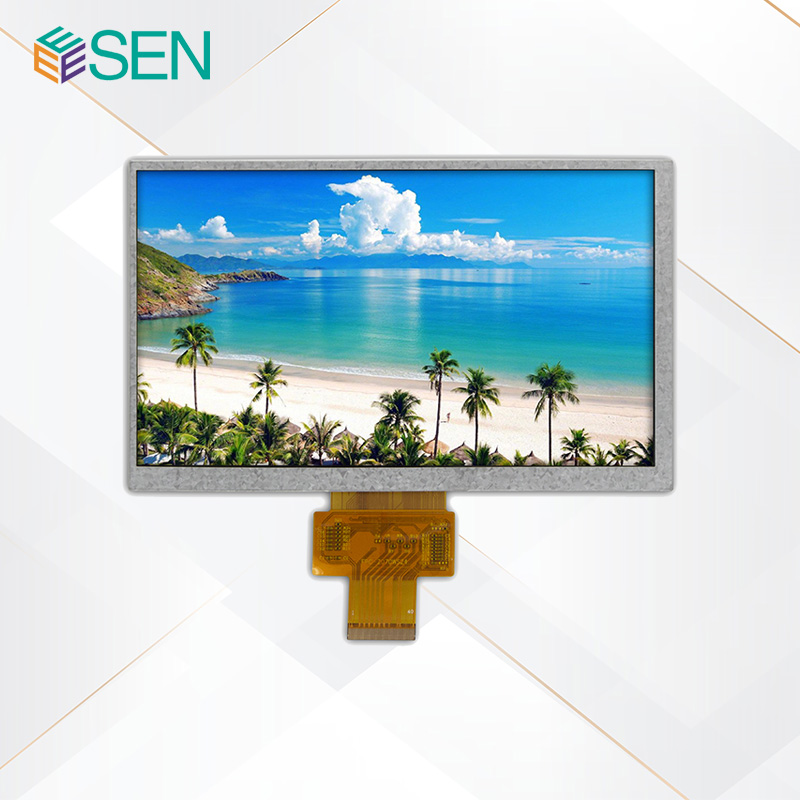
The main uses of liquid crystal properties:
① Relative temperature T: It is necessary to ensure that the entire system is in the required temperature range and there is no crystal precipitation or other phase states, such as near crystal equality;
② Dielectric coefficient Δε: adjust Δε Meet user requirements for threshold voltage;
③ Optical anisotropy Δ n: Adjustment Δ Satisfy user requirements for different box thicknesses;
④ Pitch P: The important parameters are to determine the box thickness and the amount of chiral agent added
33 Precautions for using LCD
⑴ The impact of ultraviolet radiation
Breaking the C-C bond breaks the polymer C-chain, affecting the aforementioned properties;
⑵ The influence of temperature
Liquid crystals are less sensitive to temperature than to ultraviolet radiation. During use, the heating time of the liquid crystal should be minimized as much as possible to avoid heating to higher temperatures, if not higher than 35 ℃ for bright spots.
⑶ Impact on the environment
Due to the liquid crystal resistivity ranging from 1011-1012, a small amount of conductive material is sufficient to reduce the resistivity Ω/cm2,
The impact of containers
It is best to use hard glass, a type of high silicon boron glass. Ordinary glass bottles are made of sodium glass, and the electrical resistivity of liquid crystals stored in glass containers is reduced.
The best conditions for storing LCD screens are sealing, avoiding light, drying, and room temperature.